Jawline, face and viscera — by hand, in Aoyama, Tokyo AGO TOKYO SALON
Hands, and nothing else
At our head salon in Aoyama, Tokyo, we work by hand. No tools. No machines. Two kinds of work: the jawline and the lower half of the face, where left-and-right differences show, and the organs, worked through the abdomen. You can have either, or both in one visit.
Within a session there is nothing to choose. You tell us what has been happening, we read your body, and the practitioner decides the approach. That is why no two sessions are the same, and why we do not sell this by the hour.
Please allow 60 to 90 minutes.
The range is deliberate. Some of it is the work; some of it is the time it takes for us to understand each other properly when we are not speaking the same first language. We would rather take that time than rush you.
You are not buying sixty minutes. You are buying what the hands decide to do with them.
The jawline, and the lower half of the face
Taku Yuyama’s own field is the jaw joint and the lower half of the face — the jawline above all, then the area around the mouth and the middle of the face. It is a narrow area. It is also the area where a small change alters the impression of a face more than anywhere else.
Left and right, and up and down
Most of what people notice in the mirror and cannot name is a difference between the two sides, or a face that has grown downward rather than forward. Those differences sit in bone and joint, not in the skin over them. That is the part cosmetic surgery is said to find difficult. It is the part we work on, with the hands.
If you would like to see those differences as numbers before you come, we have a free self-check that measures them from a five-second video of your own face — fourteen points, in millimetres. The page is in Japanese only. Nothing leaves your phone: the video is never uploaded.
Before cosmetic surgery, or after it
Either is fine. The work is gentle and does not hurt, so it puts no load on you on the way in or on the way out. Tell us what is planned or what has been done, and when.
One thing we look at that most people do not: where your tongue rests. If it does not sit up against the palate, the mouth tends to stay open, and the face is pulled downward over the years rather than forward — the corners of the mouth, the chin, the line under the eyes. So when someone asks us to loosen the corners of the mouth, we look at the tongue first. Working the muscle alone does not hold.
We do not diagnose and we do not treat. We are not dentists and not doctors. If what we notice belongs to a dentist or a doctor, we say so and we say it plainly — that is the whole of our part in it.
Know which one you want already?
The next three sections explain the abdominal work. You do not have to read them to book.
How we read your body
The next three sections are about the abdominal work — how we read the body, what the hands do, and what can happen afterwards.
We call it block theory. Take the ribs as the top face and the pelvis as the bottom face, and read everything between them as one cylinder.
That cylinder is squashed out of shape by how you stand and sit, and pressed down by gravity. The organs leave the positions they should hold, and descend. What squashes it, day to day: posture, what you eat, what you carry mentally, how little you sleep, how little you move.
Why the organs, and not the muscle over them
Among everything the organs do, one of the most important is making hormones. The brain decides which hormone and how much; the organs make it to that order. So the brain and the organs are two ends of one line. AGO works on both ends — which is why this technique came out of a practice that began at the jaw joint.
What the hands actually do
In acupuncture there is a sensation called de qi — the moment the needle catches and the tissue answers. We reach it with the fingers instead of a needle.
The practitioner sinks to a depth and then stops dead, holding their pressure against the pressure your tissue returns — one to one. Press harder and the body guards; press less and the finger slides. Only in that balance does the tissue let anything through.
Then one finger lies flat on the skin and a second stands on its nail, drilling down along the meridian and holding. The arm stays completely slack. Depth and direction come from the practitioner moving their own centre of gravity by a few millimetres, not from pushing.
So it should not feel like force.
If you have had deep abdominal work before and braced against it, this will not be that. Bracing is the one thing that stops it working.
What to expect afterwards
We would rather tell you this now than have you wonder later.
You may feel light-headed
The organs carry a great deal of blood, and this work reaches them directly, so blood pressure can shift. During or after the session you may feel light-headed, unsteady on standing, or simply unwell. It is most common the first time. Say so straight away, breathe slowly, and drink water afterwards.
Your body may react for a day or so
Because the work reaches the brain and the organs at once, the change can be abrupt. If your body is not used to it, you may feel off for a day while it settles. It passes.
This is not medical treatment and it does not replace seeing a doctor. If you are pregnant, are being treated for a condition, or have had abdominal surgery, tell us when you book so that we can decide together whether this is right for you now.
Who you will see
By Taku Yuyama, who created the AGO method® — Butterfly touch® outside Japan — or by one of the instructors who teach it. Only at the head salon in Tokyo.
- 20yearsIn manual therapy
- 70,000People treated
- AbroadSeminars in Los Angeles, 2024, and Taipei, 2025
- ForbesFeatured in Forbes JAPAN
He wrote One minute a day of jaw exercises, and depression fades away (Kawade Shobo Shinsha, 2022), published in traditional Chinese for Taiwan, Hong Kong and Macau in May 2024. There is no English edition. More about Taku Yuyama →
As a doctor, I have felt the effect myself. It is a safe treatment.
Dr. Chika Muto — Director, Moto-Azabu Hills Medical Clinic
I believe this method has the potential to help resolve problems of the jaw.
Dr. Hiroshi Murakami — Director, Murakami Hiroshi Dental Clinic
He works in Japanese. You do not have to.
A translation device sits on the table for the whole session and runs both ways by itself, so you can say something mid-work without anyone stopping to tap at a phone.
It is a machine, so it will get things wrong. When it does, we slow down and show you with the hands instead.
Fee
Three sessions, all at the head salon in Aoyama, Tokyo, with Taku Yuyama or an AGO instructor. The fee is the same either way. By appointment only.
-
The work we are known for
AGO Visceral Manipulation
¥66,000tax included60 to 90 minutes. The abdomen: the organs are eased back to where they belong, so the trunk stops pulling on everything above it.
-
The jawline
AGO Method — jawline and lower face
¥66,000tax included60 to 90 minutes. The jawline and the lower half of the face, where left-and-right differences show. This is the work Taku Yuyama built.
-
Both, in one visit
Face and abdomen
¥110,000tax includedAbout two hours. The jaw sits on top of the trunk, so the two are related. If you have come a long way, this is the one visit that covers both.
You pay afterwards, not in advance
We settle at the end of your visit. Nothing is taken when you book.
Visa, Mastercard, JCB, American Express, Diners Club and Discover. Many small businesses in Japan still take cash only, so we will say it plainly — you do not need to bring cash.
Case-study rate — half price
We have given this work in Japan for years, but every case we can show is Japanese. We would like to change that, and we need people willing to be the first.
If you agree to let us photograph your session, and to publish your first name and what you noticed afterwards on this website, the fee is half. You see anything before it goes up, and you can ask us to take it down at any time.
The form below asks you to choose. Choosing not to changes nothing about the session itself.
Book a session
Please fill in the form below. We will be in touch within three days about the date and time.
Thank you for your request
We will be in touch within three days about the date and time.
If it is urgent, please call +81 90-3092-7966 (we may not be able to answer during a session).
Access
- Address
- 316 Aoyama 302, 3-1-6 Kita-Aoyama
Minato-ku, Tokyo 107-0061, Japan - Getting here
- 8 minutes on foot from Omotesando Station
5 minutes on foot from Gaienmae Station
One street back from Aoyama-dori, in quiet Kita-Aoyama. - Phone
- +81 90-3092-7966 We may not be able to answer during a session. The form is the sure way to book.
- Opening hours
- 8:00 – 22:00, every day Weekends and public holidays included. A practitioner comes in once a booking is made, so we cannot take walk-ins.
- Booking
- By appointment only. Allow 60 to 90 minutes.
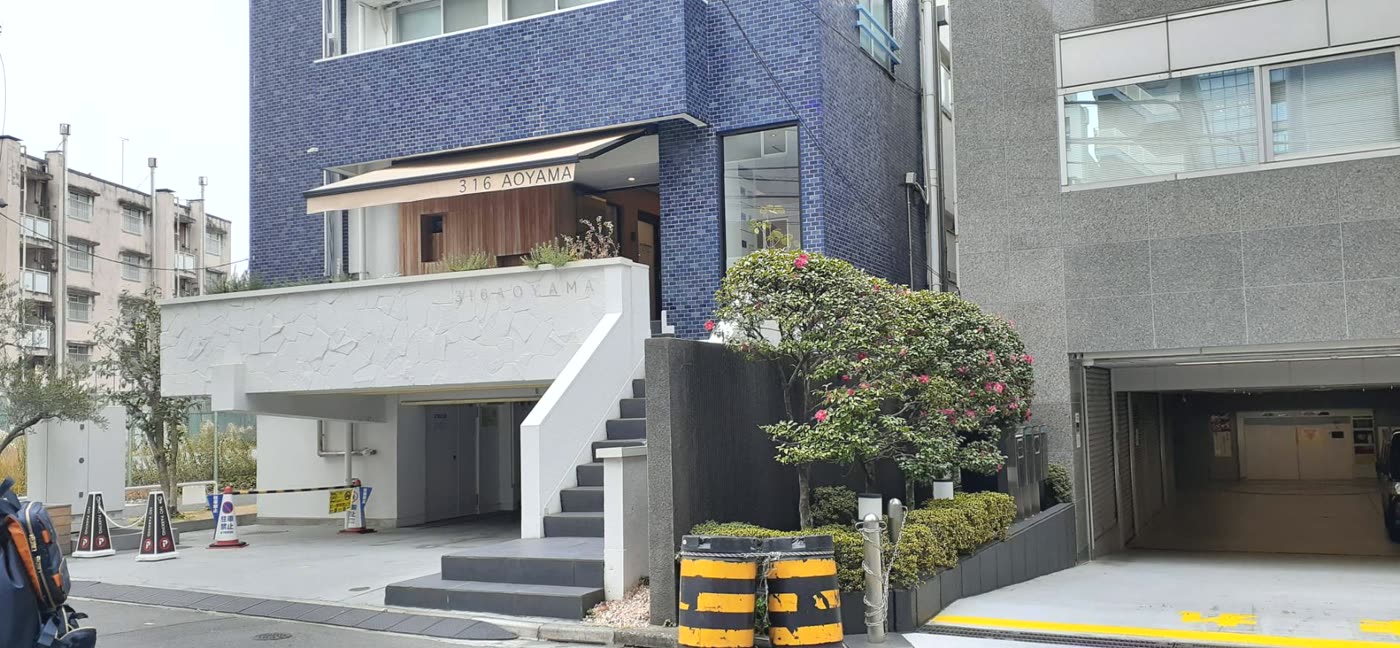
1 · The buildingBlue tiles, one street back from Aoyama-dori. The name 316 AOYAMA is over the entrance. Take the steps up on the right. 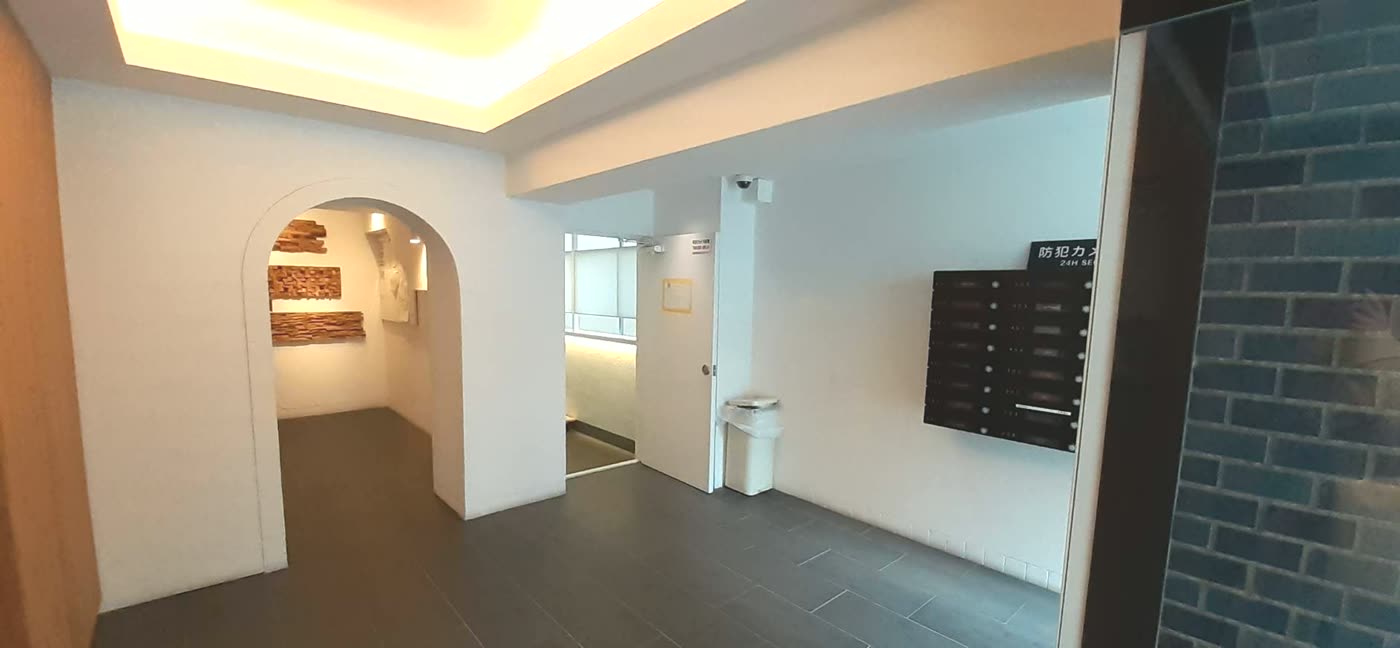
2 · Inside the entrancePost boxes on your right, an arch on your left. Go through and take the lift to the third floor. 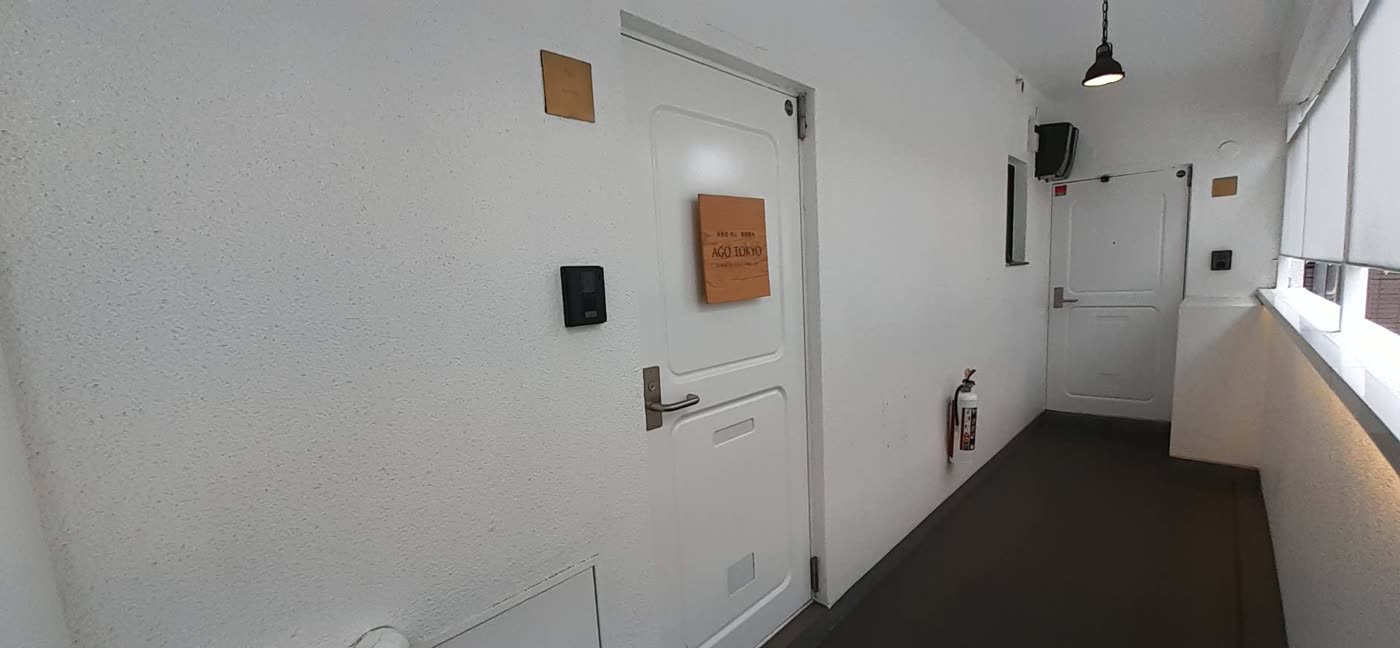
3 · Room 302Out on the walkway. The wooden plate on the door reads AGO TOKYO. Ring the bell beside it.
If you want to learn it
We teach this technique to practitioners, over seven days in Tokyo.
Common questions
How much does a session cost?
Jawline and lower face (AGO Method): ¥66,000, 60 to 90 minutes. The organs through the abdomen (AGO Visceral Manipulation): ¥66,000, 60 to 90 minutes. Both in one visit: ¥110,000, about two hours. Tax is included, and the fee is the same whether you see Taku Yuyama or an AGO instructor.
Do I need to speak Japanese?
No. A translation device sits on the table for the whole session and works both ways, so you can speak at any point. When it gets something wrong, we slow down and show you with the hands instead.
How do I pay?
You pay at the end of your visit; nothing is taken when you book. We accept Visa, Mastercard, JCB, American Express, Diners Club and Discover, so you do not need to bring cash.
How do I book? Can I walk in?
Please use the booking form on this page; we will be in touch within three days. Sessions are by appointment only and we cannot take walk-ins, because a practitioner comes in once a booking is made. Phone: +81 90-3092-7966 (we may not be able to answer during a session).
Where are you, and when are you open?
316 Aoyama 302, 3-1-6 Kita-Aoyama, Minato-ku, Tokyo 107-0061. 8 minutes on foot from Omotesando Station, 5 minutes from Gaienmae Station. Open 8:00 to 22:00 every day, weekends and public holidays included.
Is there a lower rate?
Yes. If you agree to let us photograph your session and publish your first name and what you noticed afterwards on this website, the fee is half. You see everything before it goes up, and you can ask us to take it down at any time.
Is this medical treatment?
No. We do not diagnose and we do not treat; we are not dentists or doctors. Please tell us beforehand if you are pregnant, under treatment, or have had abdominal surgery.
Can I learn the technique?
Yes. We teach AGO Visceral Manipulation to practitioners over seven days in Tokyo.